

Prince Philip, the doyen of the ‘foot in mouth’ brigade once made a splendid gaffe at a meeting of the World Wildlife Fund, saying that “if it has got four legs and it is not a chair, if it has got two wings and flies but is not an aeroplane and if it swims and it is not a submarine, the Cantonese will eat it.” He’s probably not far from the truth and while the phrase ‘you can use every part of the pig bar its squeal’ is almost universally acknowledged, there are certain parts of the animal that I’ll happily pass on to the Cantonese.
Thailand thoroughly deserves its reputation for excellent street food but it’s fair to say that it also has a fair range of gastronomic oddities that many farang (foreigners) shy wary of – and often with just cause. One of the country’s most famous fruits, which you either love or hate, is durian, a creamy fruit that emits such an appalling stench of foetid flesh that many hotels and all railways display a prohibition sign similar to that of a no-smoking area – a red circle with a cross over the spiky fruit in lieu of a cigarette. Aficionados claim that the soft, creamy centre is akin to ambrosia, but I’m one of those who believe that this most disgusting fruit has absolutely no redeeming features whatsoever! Being close to it is one of the few times in my life that I’m grateful for having no sense of smell, but my sense of taste is good enough to know that it’s sludgy mush of an interior tastes as disgusting as I’m told it’s ‘aroma’ smells.
Insects are another ‘delicacy’ I tend to be wary or, although an adventurous palate can still bring me grief, as this story of a visit to the Buffalo Market at San Patong, near Chiang Mai, Thailand explains.
Everything but the squeal.
As the morning drifts on it’s time to eat. A brief glance at a stall selling cooked and live insects (the larger ones with their legs restrained by elastic bands to stop them doing a runner – a painstaking job if ever there was one) and I move on. I’ve tried various varieties and not been particularly impressed; crickets, which I dislike because their crispy fried legs get stuck between my teeth, the silk worm has a pulpy texture that I find distasteful, and a large bug called a mengda, which translates into ‘pimp’ in English, so called because it follows the female around, is so close to looking like a cockroach that I find the idea of putting it in my mouth totally repellent.


I stop at vegan hades, a rustic kitchen whose menu is made up entirely of the innards and gizzards of pigs and chickens. Once used raw for the traditional spicy mince northern Thai dish, larb, they are now usually cooked, either in stews or grilled, although the dark paste fermenting in an aluminium pan at the side of the gas burners looks a bit suspect. On the battered old charcoal grill slabs, curls and misshapes of pigs’ guts are cooked, including a thick tube that my Thai friend, Kai, a nickname that – aptly – translates as ‘chicken’, who I previously considered the font of knowledge of all Thai edible delights, describes simply as ‘pig’s dick’, although I was always under the impression that a pig’s penis was corkscrew-shaped.
Two large aluminium bowls are simmering away, one the colour of rich brown gravy with chillies, kafir lime leaves and an assortment of things I try not to look at too closely; tom som, which turns out to be a soup of chickens’ innards, including tiny hearts and a handful of miniscule un-formed eggs. I’m told the abundance of spices is to cover the smell and flavour of the animal ingredients. The lady cook persuades me to sample it, plus a small bowl of aom curry, something to do with beef but I really don’t want to pursue the ingredients any further. Both are reasonably tasty in a thick, spicy sort of way and working on the premise that the best way to jump off a height into water is to hold your nose, the best way to eat at any of these stalls is to close your eyes and try not look at what’s on the spoon.
While I’m savouring these rustic delicacies a customer extols the delights and benefits of the ‘pig’s dick’ so I finally give in and accept a slither. About as chewy and tasteless as anything I’ve ever put in my mouth. I ask Kai to find out what the Thai name is. When the uproarious laughter finally settles it seems that it wasn’t pig’s dick after all, simply the pig’s large intestine, but the staff and customers thought it was hilarious that this farang would eat pig’s penis, even just to sample local gastronomy. Too late, I’d swallowed it by then.

Turning the other cheek
Step across two continents to Spain, where a marginally less odiously ugly local speciality is about to be sampled.
It’s almost two o’clock, the beginning of the Spanish lunch break, and I stop off at Valencia’s Mercado Central to nibble on something tempting. The gorgeous early nineteenth-century monument to gastronomy is said to be the oldest covered food market in Europe, although as it’s the market authorities who say so, (as those who run Barcelona’s La Boqueria also say about their own market), who am I to argue?
I stop off at Palomo, one of the caffs that form the periphery of the Mercado, and about the only place in the city that still serves the working-mans’ favourite of cabeza de cordero, half a sheep’s head roasted in the oven with potatoes and onion. A single remaining half-head sits forlornly in a metal tray, soaked in pan juices. “You’re lucky”, the smiling lady in her frilly apron tells me. “It’s the last one,” which makes me think that being unlucky isn’t always a bad thing.
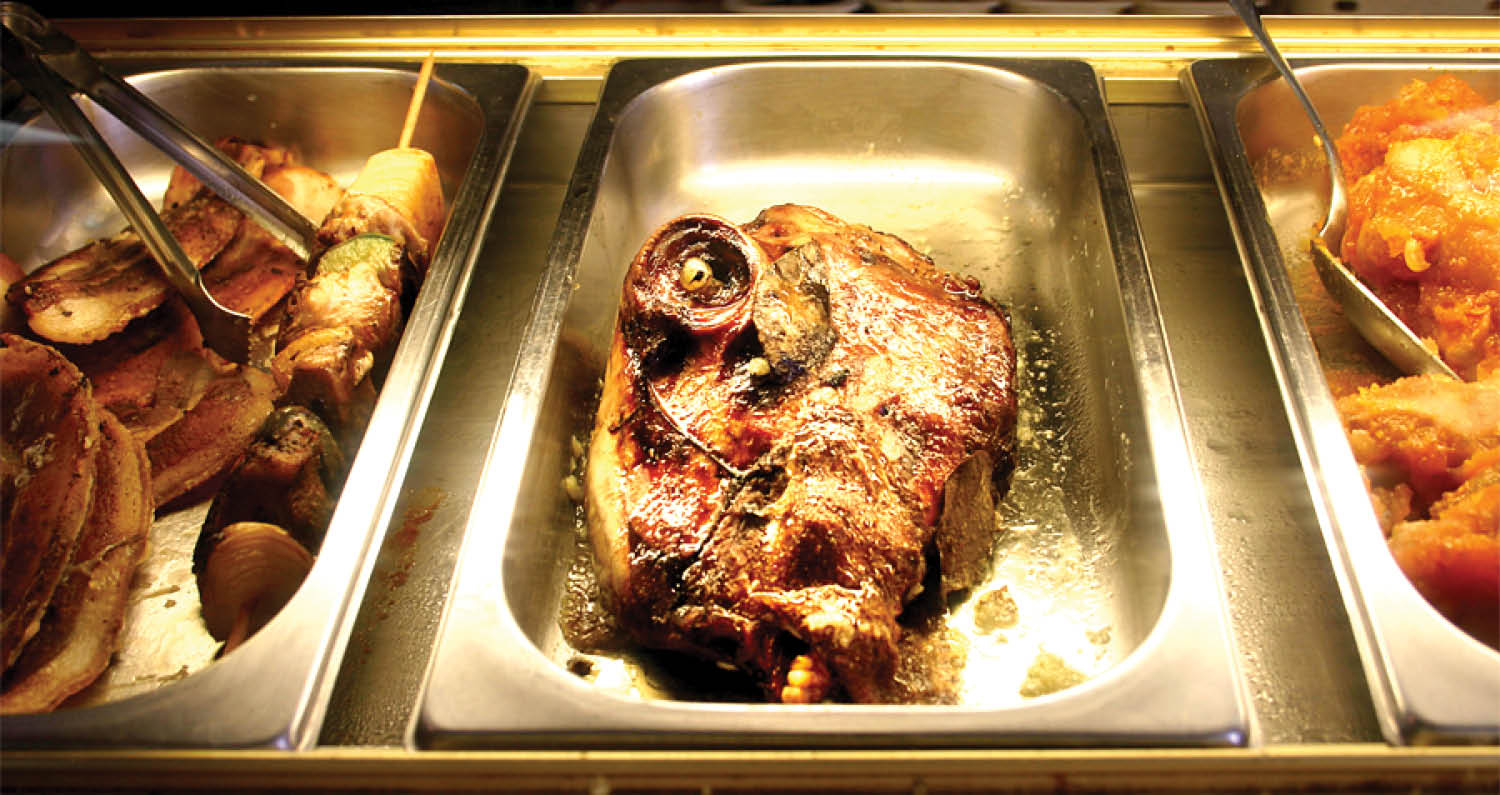
As well as the last half-head, I get the last seat at the counter, and order a glass of white wine so rough that it justifies the old Spanish saying, los mejores blancos son tintos, the best whites are reds. The dish is placed in front of me and I stare down at it. My stare is returned by a small shrunken blob, all that remains of the eye after its sojourn in the oven; the skin has peeled back from the teeth to reveal a hideously evil grin. I flip it over, not wanting to share its morbid joke and to avoid the skeletal glare of the almost empty eye socket.
We hear of people asking photographers to make sure they get their ‘best side’; that is the sheep’s ‘best side’. The teeth on the inside are also bared, so not only do I not escape the demonic grin, I’m presented with half a well-browned roast brain, which ranks along with pig’s trotter as my favourite dish to scrape off a plate into a waste disposal unit. I flip the cabeza back over.
To be fair, the cheek meat is delicious, but sheep have very small cheeks, barely enough to fill a finger-loaf sandwich.
I thoroughly enjoy the potatoes, though.
Leave A Comment